
Buying guide
Best trash bags that do not rip
Rip-resistant trash bags are a match of size, thickness, and how full you pack the can. What to read on Hefty and Glad boxes before you buy a bundle.
Updated 2026-11-20. About 5 minute read. Written by Logan for Stocked Home.
A trash bag rips for ordinary reasons. It is too small for the can, it is asked to carry a broken edge or a wet load it was not sized for, or the plastic is thin and the knot is doing all the work. Marketing answers with the word strong. Shopping answers with the gallon rating, the count in the box, and whether the bag fits the can you already own.
No bag was filled with cans and dropped down a staircase for this guide. A drop test on a video is hard to compare unless you know the weight, the height, and the exact product. Skip that theater. Use the specs that are printed, and use the habit of not overfilling, which beats a thicker bag that you still pack until the plastic sings.
Fit first, thickness second
Look at your can. Tall kitchen cans are commonly in the neighborhood of 13 gallons. A bathroom can is much smaller. A contractor bag is a different object for yard waste and heavy debris, not for orange peels. Hefty Strong Tall Kitchen Trash Bags and Glad ForceFlex Tall Kitchen Trash Bags are both aimed at the tall kitchen can. Glad Small Trash Bags are the smaller bags for bathroom and office cans. Buying the kitchen bag for a tiny can wastes plastic and money. Buying the tiny bag for the kitchen guarantees a rip, because you will overload it.
- Bulk deal

Kitchen & trash
Hefty Strong Tall Kitchen Trash Bags
The kitchen-can liner you replace every few days. Compare counts on Amazon.
See price on Amazon
Opens this product on Amazon
- Bulk deal
Kitchen & trash
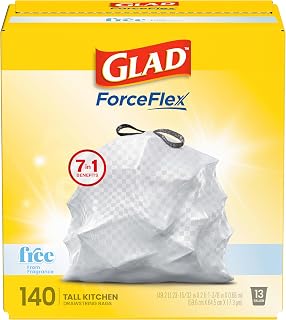
Glad ForceFlex Tall Kitchen Trash Bags
Stretchy kitchen bags for cans that get a little too full.
See price on Amazon
Opens this product on Amazon
Kitchen & trash
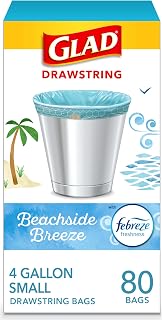
Glad Small Trash Bags
Bathroom and office-can bags, smaller than the kitchen box.
See price on Amazon
Opens this product on Amazon
ForceFlex, in Glad's naming, is a stretch claim. Stretch helps when a bag needs to conform around an awkward load. It is not a promise that any weight is fine. Hefty Strong is the other everyday kitchen bag people use as a benchmark. Open both current listings and compare gallon size, bag count, and price per bag. If one box is 80 bags and the other is 40, a lower box price can still be the worse buy. Divide the live price by the count. That number is the comparison. It will change, so do it on Amazon, not from memory.
What mil means, and when it is missing
Thickness is sometimes printed in mils. A higher mil is thicker stock. Thicker is not always tougher if the seams are the weak point, but a clearly thicker bag is a reasonable thing to pay for if your kitchen waste is wet or heavy. Many consumer boxes do not print a mil at all. When they do not, you cannot invent one. Compare the bags you can inspect: the gauge you can feel on a single bag from a box you already own, and the failure you actually get. If your current bag fails at the drawstring channel, a thicker film will not fix a seam. If it fails because a chicken bone pokes a hole, thickness and a habit of wrapping the sharp thing both matter.
Drawstring bags are easier to close and easier to over-trust. The string is not a handle for a 30-pound load. Tie a knot as well if the bag is heavy. Flap-tie bags can be cinched tighter. Neither style is morally superior. Pick the one you will close before the walk to the curb.
How bags are asked to fail
Overfilling is the main request. A bag that is comfortable at three-quarters full becomes a science experiment at the rim. Wet coffee grounds in the bottom, plus a long carry, plus a thin spot, is a kitchen-floor story everyone has. Two modest bags beat one heroic bag. The calculator on the monthly supplies page is there so you buy enough bags to use them this way. Running out is why people overload.
Sharp edges want a wrap of something stiffer, or a different bin. A pizza box corner and a broken glass lid are not a fair test of a kitchen bag. Wrap glass before it goes in. That is cheaper than any premium film.
Heat and sun age plastic. A box stored in a hot garage can get brittle before you have used it. Buy a count you will finish, and keep it in the house. A "stock up" of bags that weld themselves into a brick is not a save.
Scents and special features
Scented bags cover a smell with another smell. They do not seal better. If you want less odor, empty the can more often and keep food scraps covered or composted if you do that. Baking soda in the bottom of the can is an old trick for the can itself, not a property of the bag brand.
Drawstring shields, extra gussets, and "flex" names are worth money only when they address the failure you have seen. If your bags split at the bottom seam, look for a box that talks about the seam, and then buy the smallest count to verify. If your bags never split and you are only annoyed by the price, buy the lower price per bag in the right gallon size and stop reading the front.
A buying rule you can reuse
Match the gallon rating to the can. Divide live price by the number of bags. Prefer a thickness or a stretch claim only after a cheaper correct-size bag has actually failed you. Keep a spare box so a rip does not push you into overfilling the last bag. Hefty Strong Tall Kitchen Trash Bags and Glad ForceFlex Tall Kitchen Trash Bags are the two kitchen benchmarks to open. Glad Small Trash Bags covers the small cans so you are not using a kitchen bag to line a bathroom basket.
Skip drop-test rankings that do not name the weight. Skip any price printed here, because there is not one. The bag that does not rip is the bag that fits, is closed before it is tortured, and is thick enough for the waste you really throw away. You learn the last part from one box, not from a slogan.